AI Minds
Giving a technology business a clear commercial architecture
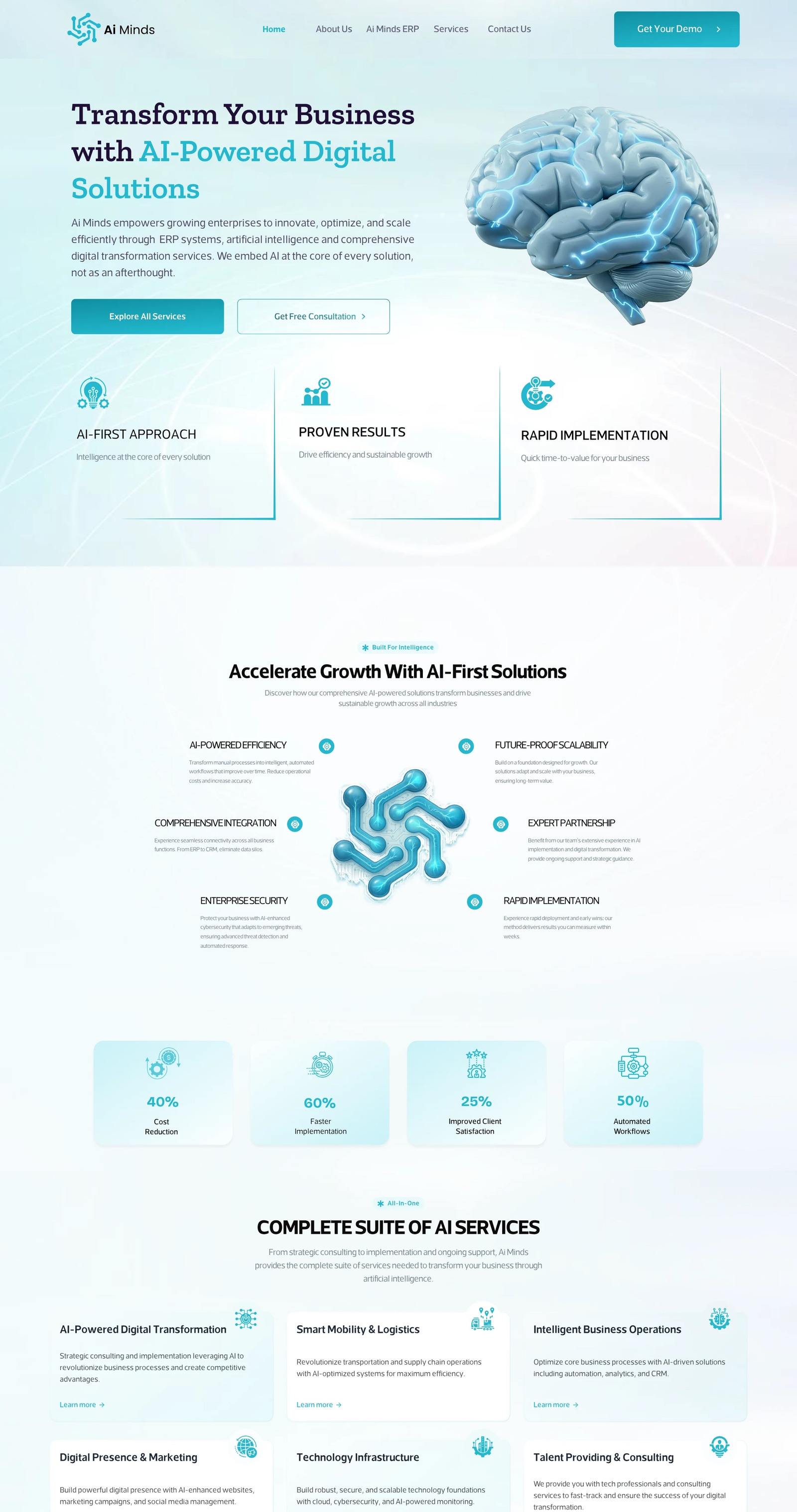
AI Minds had to explain an AI and digital-transformation business, six service families and an ERP product on the same website. I worked on the research, content strategy, information architecture and English/Arabic writing that connected those offers without making every page carry the whole company story.
Market research, content strategy, information architecture and English/Arabic UX writing. Visual design and development were shared with the wider team.
The project at a glance
AI Minds is a Saudi-facing technology company offering its own ERP system alongside AI and digital-transformation services. I worked on how the website introduces the company, separates its services and explains the product, in English and Arabic.
Websiteai-minds.com
- Market
- Saudi Arabia
- Project type
- Company website
- Languages
- English · Arabic
Scope
- Research
- Information architecture
- Bilingual website content
- UX writing
- Search-aware copy
Deliverables
English and Arabic content for the company website, service families, ERP modules and sector explanations, including the component-level copy shown here.
Select a screen to open the full-size image.
A broad offer creates a difficult buying decision
A visitor could arrive at AI Minds looking for a business system, help with digital transformation or a specialist delivery team. Those are different purchasing situations. A finance lead assessing an ERP system needs to understand functions and business fit; a company considering AI consultancy first needs to understand the problem the engagement will address.
The website therefore needed a commercial hierarchy before it needed more persuasive sentences. Putting every capability under one AI promise would leave the reader to work out which parts were products, which were services and how they related. I treated that distinction as a content and information-architecture problem.
My contribution covered market research, content planning, page structure and writing in both languages. I worked alongside the design and development team. The original materials include the company pages, service variants, ERP modules and industry components, so the work can be examined at the level of the whole offer and the individual explanation.
Company, service and product each need a different argument
The company layer establishes who AI Minds is and the range of work it undertakes. The service layer explains the kinds of engagement available. The ERP layer gives a named product enough space to be evaluated on its own terms. That separation gives the visitor a way to narrow the question instead of restarting the same introduction on every page.
I organised the company content around its proposition, approach and expertise, while the homepage connected that identity to the service families and industry-specific ERP offer. The About page could hold the mission, vision and areas of expertise without interrupting the product explanation.
This is where content strategy meets business strategy: the architecture makes the commercial model legible. A reader can investigate the provider, explore an engagement or evaluate a system. The website connects those decisions while allowing each one to develop at the right level of detail.
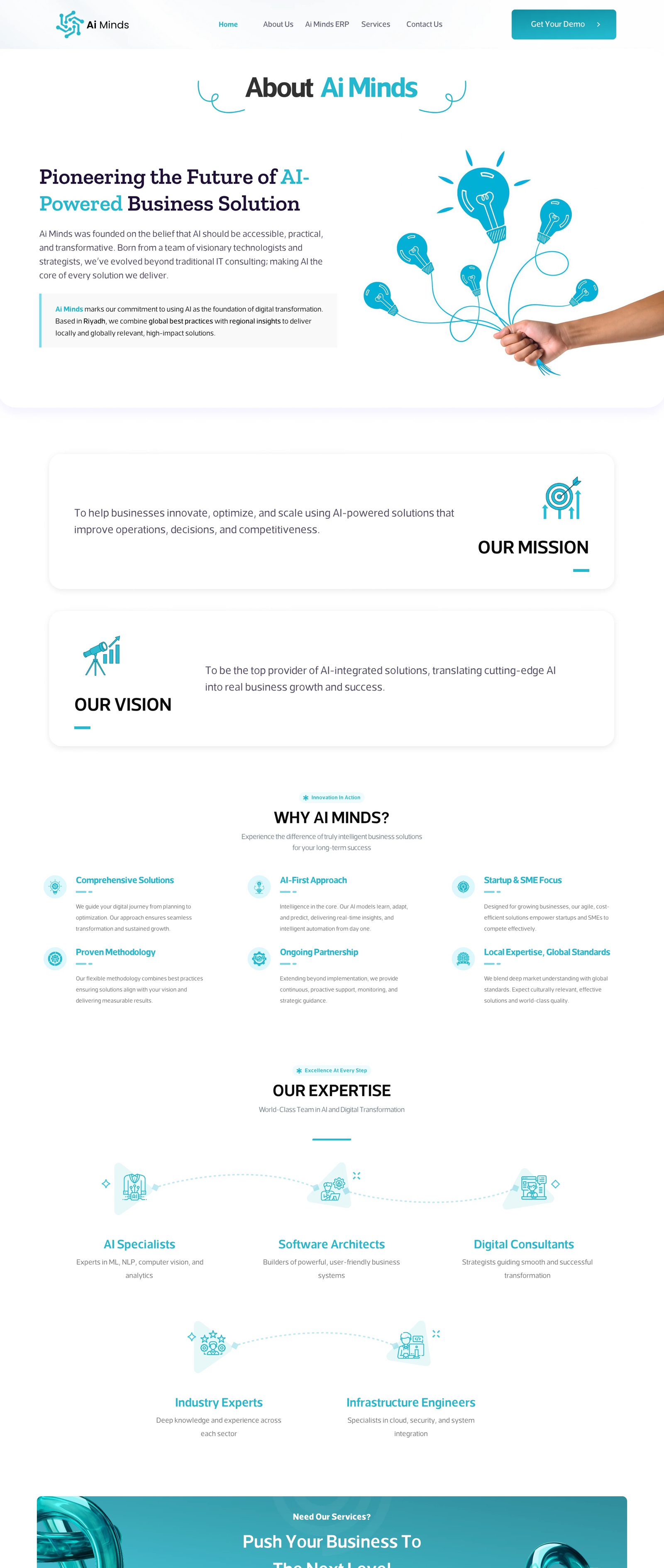
Company identity and expertise have space of their own, separate from the product explanation.
The service components reveal the real content work
The service offer spans digital transformation, mobility and logistics, business operations, digital presence, technology infrastructure, and talent and consulting. Naming those families is only the first layer. Each selected service needs to explain its own problem, scope and reason to continue.
The original business-operations component is a useful example. It separates project management, workflow automation and business intelligence. The explanation then becomes more specific: anticipating delays and allocating resources, reducing repetitive tasks, and turning business data into reports and decisions. The repeated visual frame supports comparison while the copy supplies the differences.
I wrote within that relationship between a stable structure and a changing argument. The category name or headline alone cannot do the job. The supporting text has to show what work the service addresses, and the detailed points have to remain connected to that explanation. The component sheets make that reasoning visible in a way a homepage crop cannot.
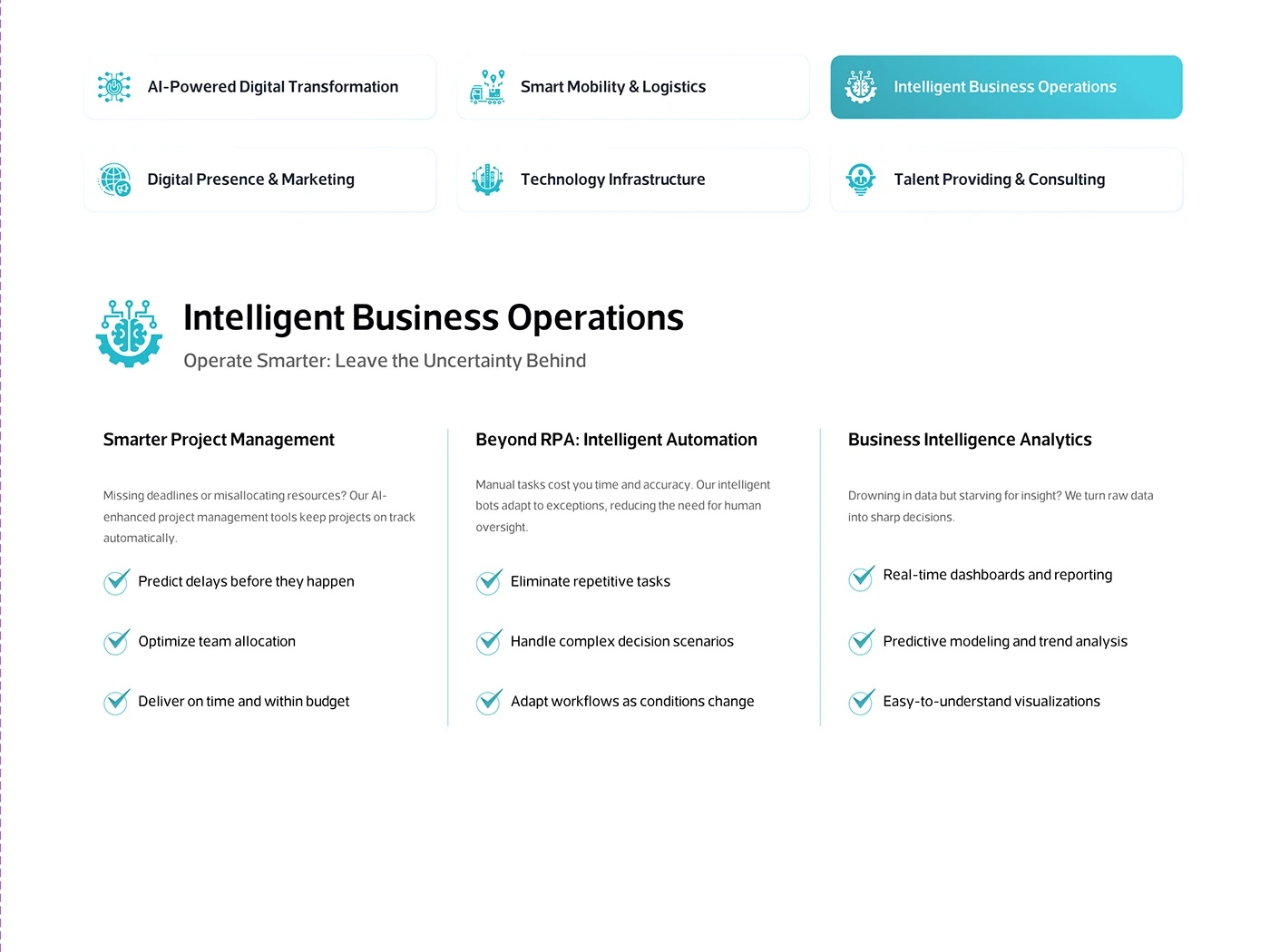
Project management, automation and business intelligence each receive a distinct explanation.
Mobility needed a scope of its own
Mobility and logistics could easily become another broad claim about efficiency. The component instead breaks the offer into recognisable operating areas, including transport platforms and the systems behind journeys and bookings. That gives a transport business a more useful starting point than a generic statement about innovation.
There is also an important architectural distinction between this service family and the transport industry inside the ERP product. One introduces a possible technology engagement; the other explains how a business system might fit a transport organisation. Keeping that relationship clear avoids making two destinations appear to sell the same thing.
The bilingual component is especially valuable evidence because the Arabic explanation has its own emphasis. Reading the two versions together reveals the work involved in defining an offer across languages, including where terminology needs an agreed commercial meaning rather than a literal equivalent.
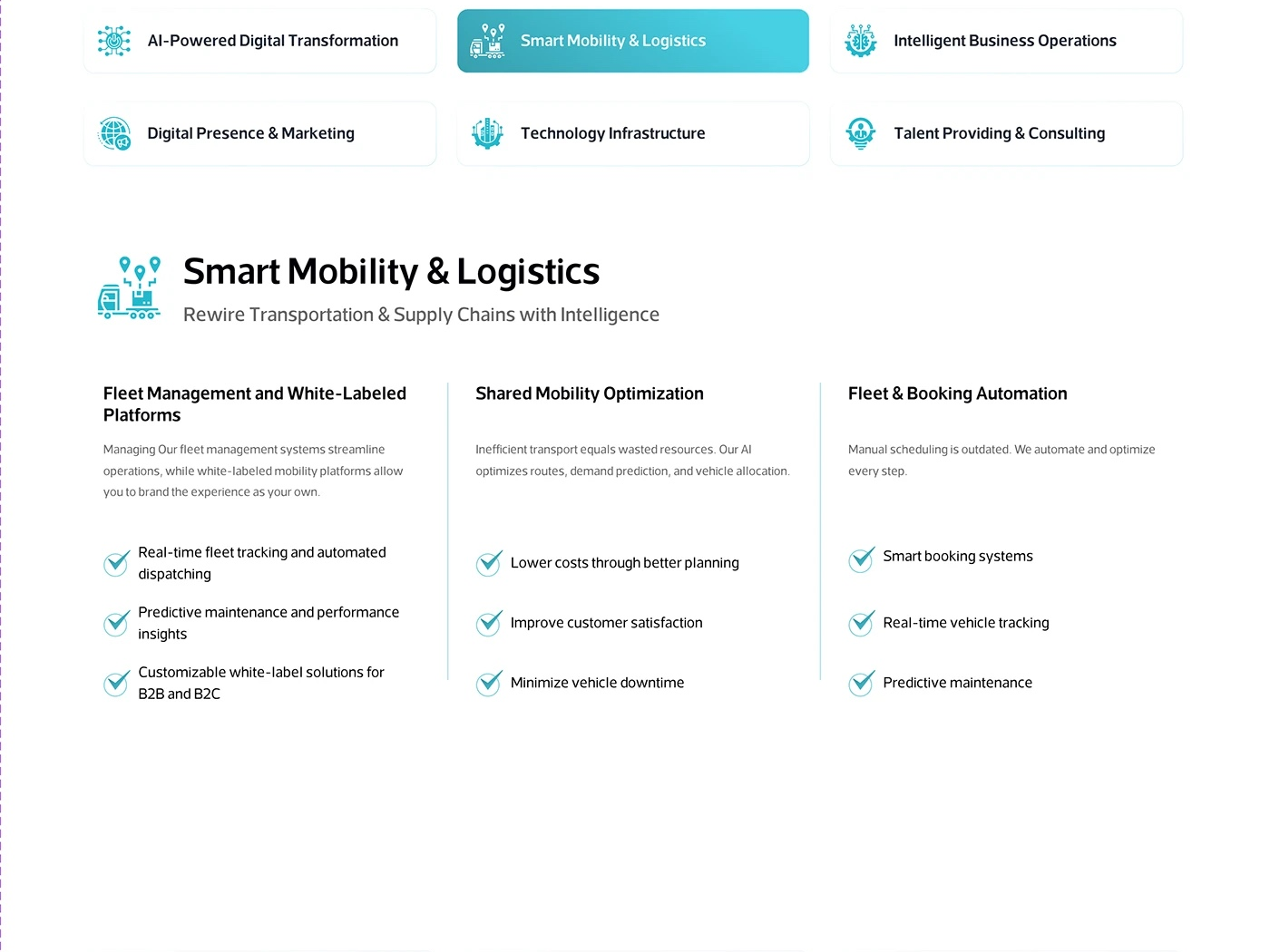
Platforms, shared mobility and booking automation make the scope of the transport offer inspectable.
An ERP module must be understandable before it is selectable
AI Minds ERP changes the conversation from an engagement to a product. The product opening gives it a name and a promise, followed by modules for finance, human resources, supply chain, customer relationships, automation and reporting. The reader can move from the overall system to the part closest to their responsibility.
The finance component combines a function name, a short value statement, an explanatory paragraph and a small set of capabilities. Invoicing, reconciliation and cash-flow visibility give the explanation concrete business subjects. The selection action sits beside that account of what the module is intended to do.
The component brings a function name, short benefit, substantive explanation and selection into one frame. That gives the copy a clear hierarchy: the reader can recognise the subject, understand its relevance and then inspect the detail. The same pattern can support comparison across the other modules without making their explanations interchangeable.
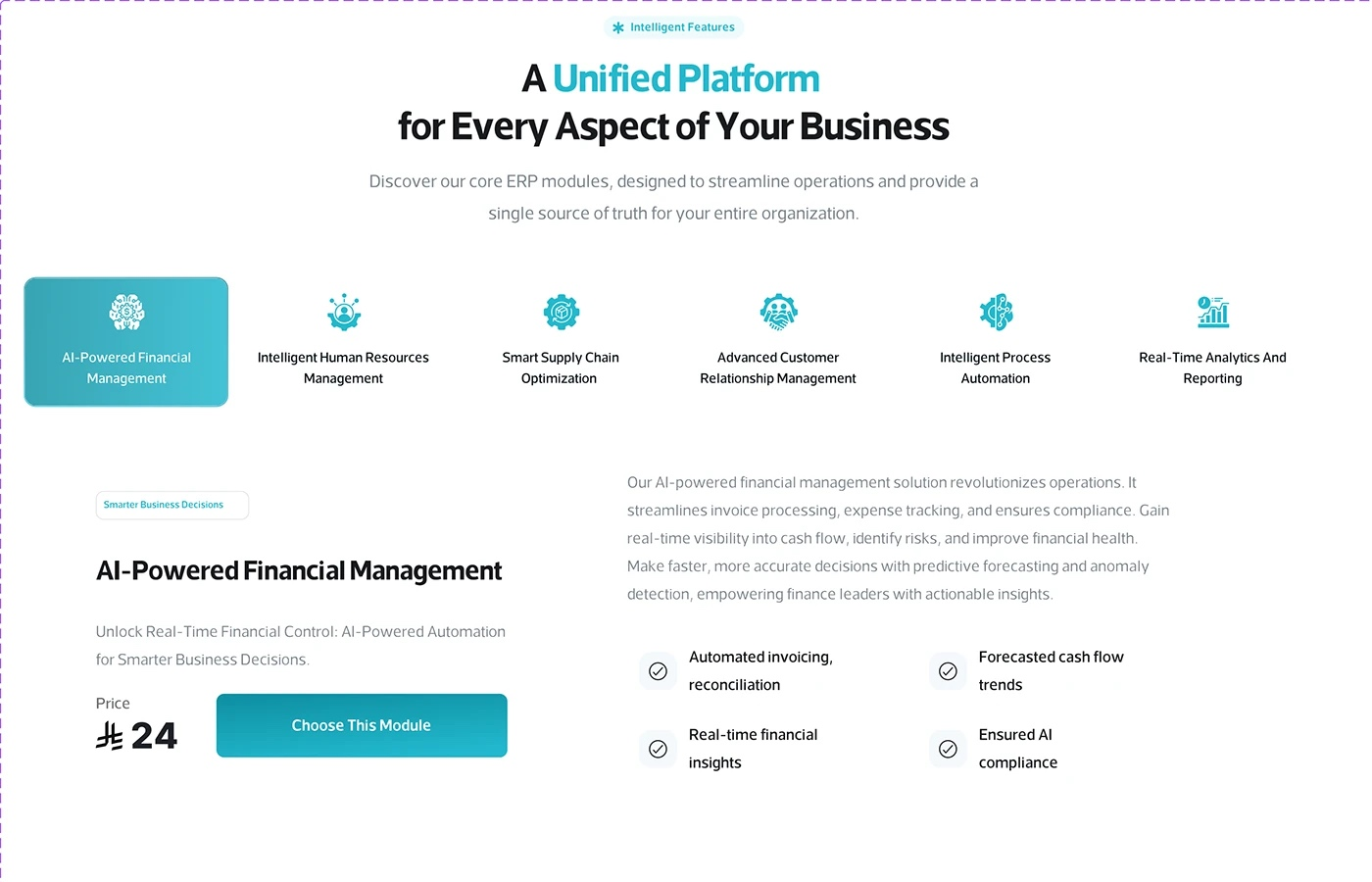
The module name, explanation and capabilities sit together before the selection decision.
Sector content changes the evaluation criteria
The industry layer addresses manufacturing, retail and e-commerce, construction and real estate, financial services, hospitality and tourism, transport and logistics, healthcare, and professional services. Those names introduce different operating contexts, even where the underlying product remains the same.
The manufacturing component gives the sector its own explanation rather than relying on a manufacturing illustration beside generic ERP copy. This is the content challenge across the set: explain why a reader in that industry should continue, while keeping the relationship to the product understandable.
The set also reveals a boundary that deserves careful editorial treatment: back-office ERP functions and specialist AI applications carry different kinds of promise. Keeping the relationship clear protects the product story from becoming a list of everything AI might do in an industry. The sector explanation should help a buyer identify a relevant discussion and understand what requires further substantiation.
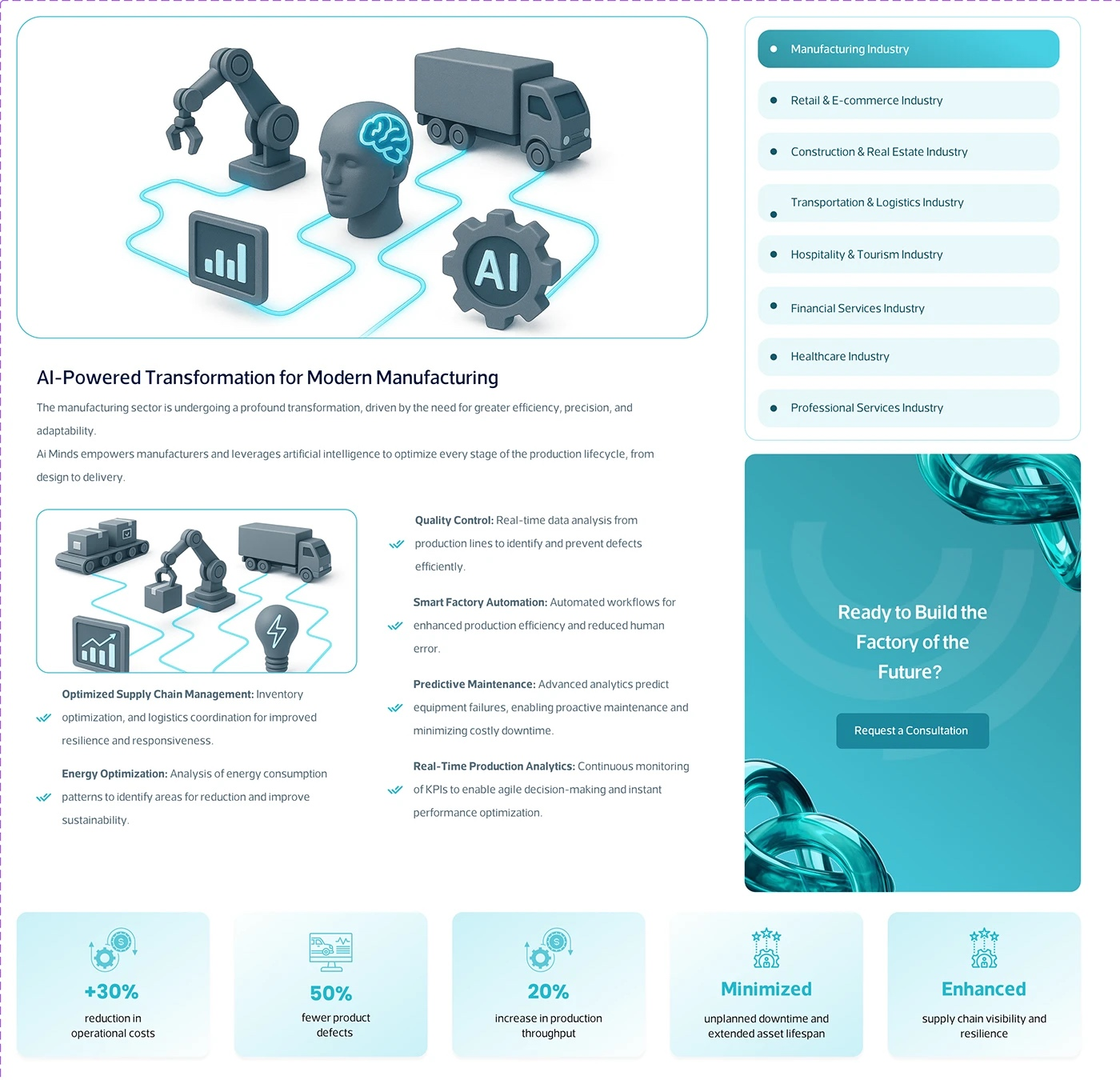
The manufacturing state changes the sector argument while retaining the ERP context.
Arabic has to explain the business in its own terms
The Arabic writing had to work for someone assessing a business investment, including readers who recognise the functions before they recognise the English category name. أنظمة تخطيط موارد المؤسسات gives ERP an explanatory context. Terms such as الإدارة المالية، الموارد البشرية وسلاسل الإمداد let the reader connect a broad system to familiar responsibilities.
The same principle applies to services. التحول الرقمي، البنية التقنية وتوفير الكفاءات need explanations of scope, not a sequence of translated labels. Arabic can develop the business benefit in a fuller sentence while English can reach the category more quickly. Both still need to lead to an intelligible offer.
The paired originals show that localisation reaches into information hierarchy and product terminology. The task is to keep the underlying commercial meaning aligned while giving each language a natural argument. This is why I treat bilingual writing as part of content strategy, with close attention to what each version promises.
Search intent belongs in the structure of the offer
The search work connects to the same distinctions. A person researching ERP software is evaluating a category or supplier. A sector query adds a business context. A transformation or consulting query can begin earlier, with the organisation still defining the change it needs. Those entry points require different explanations.
I used search-aware wording within the company, service and product architecture rather than turning the website into a collection of disconnected keyword pages. Module names establish the subject of the ERP content; sector explanations add relevance; service descriptions establish the scope of an engagement. Internal routes should help a reader move between those levels.
The resulting content gives each destination a recognisable subject and purpose. The homepage introduces the company and the routes into its offer; service explanations define engagements; the ERP and sector content develop a more specific evaluation. That relationship is the practical connection between positioning, content strategy and search-aware information architecture in this work.
Other language editions and supporting screens
Original evidence selected for comparison and a fuller view of the work. Open a screen to read the full-size export.
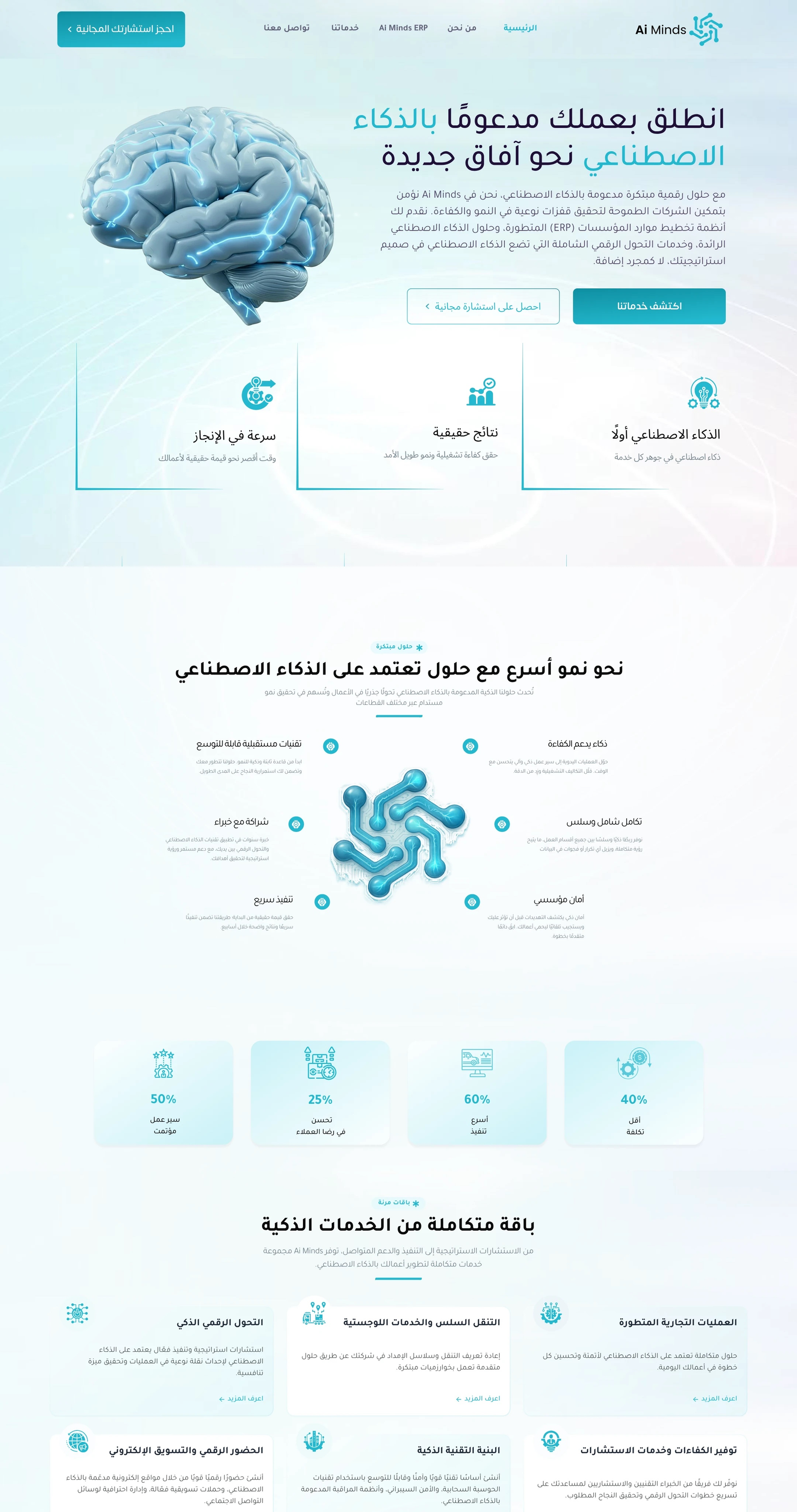
The homepage connects the company proposition with the service and ERP offer.
Scroll either edition and the other follows, section by section.
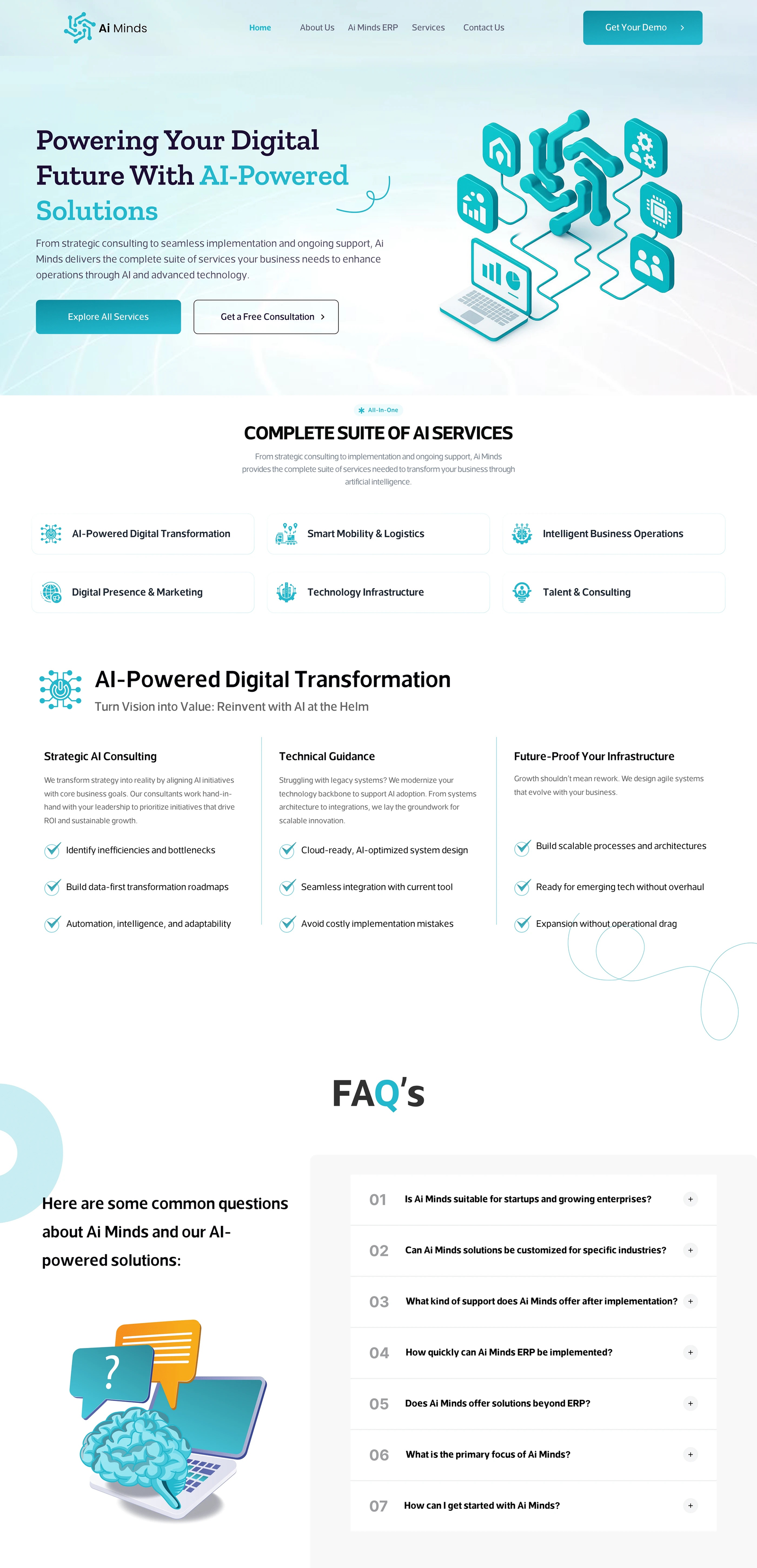
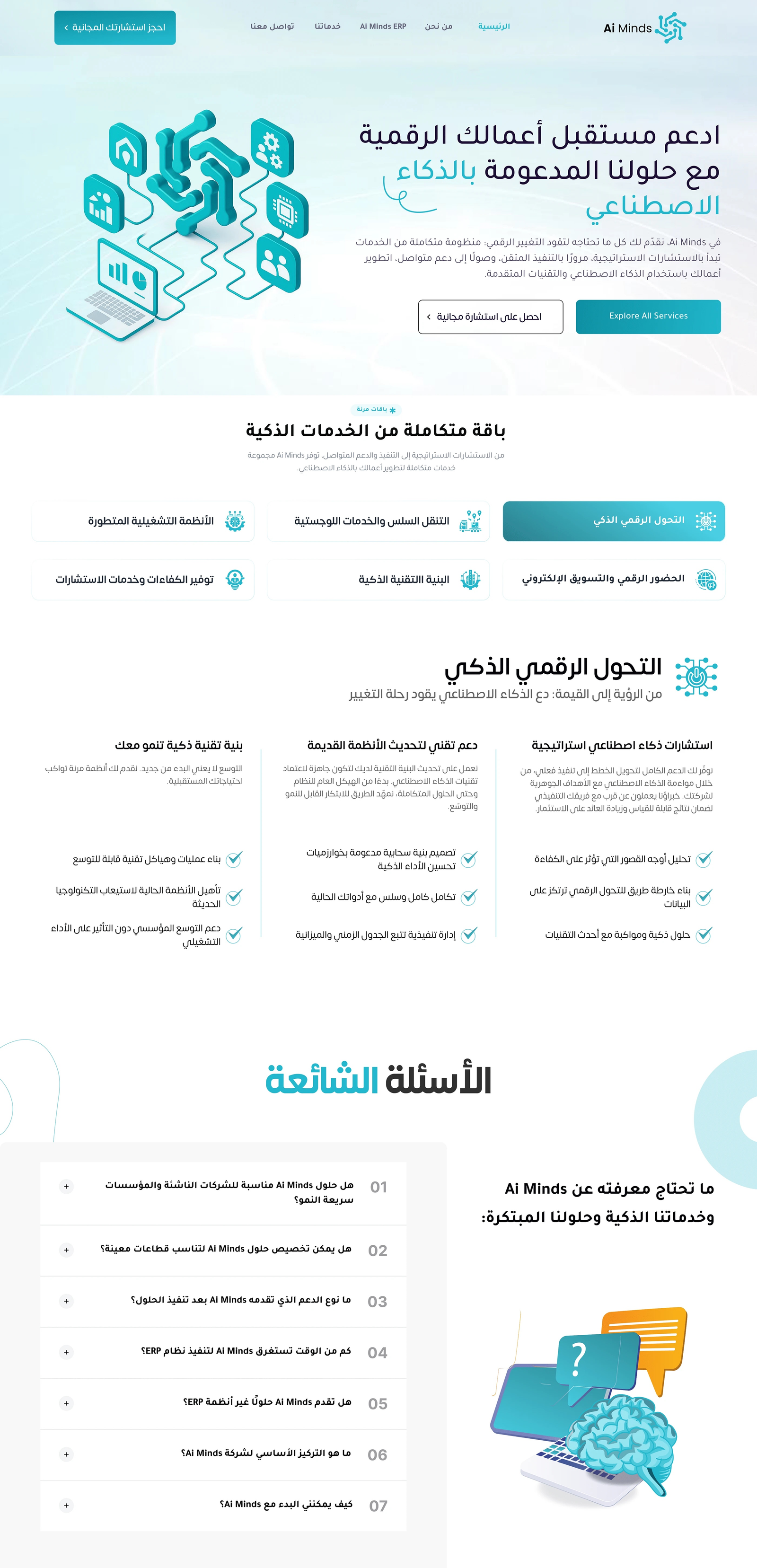
The six service families introduce different engagements within one shared structure.
Scroll either edition and the other follows, section by section.
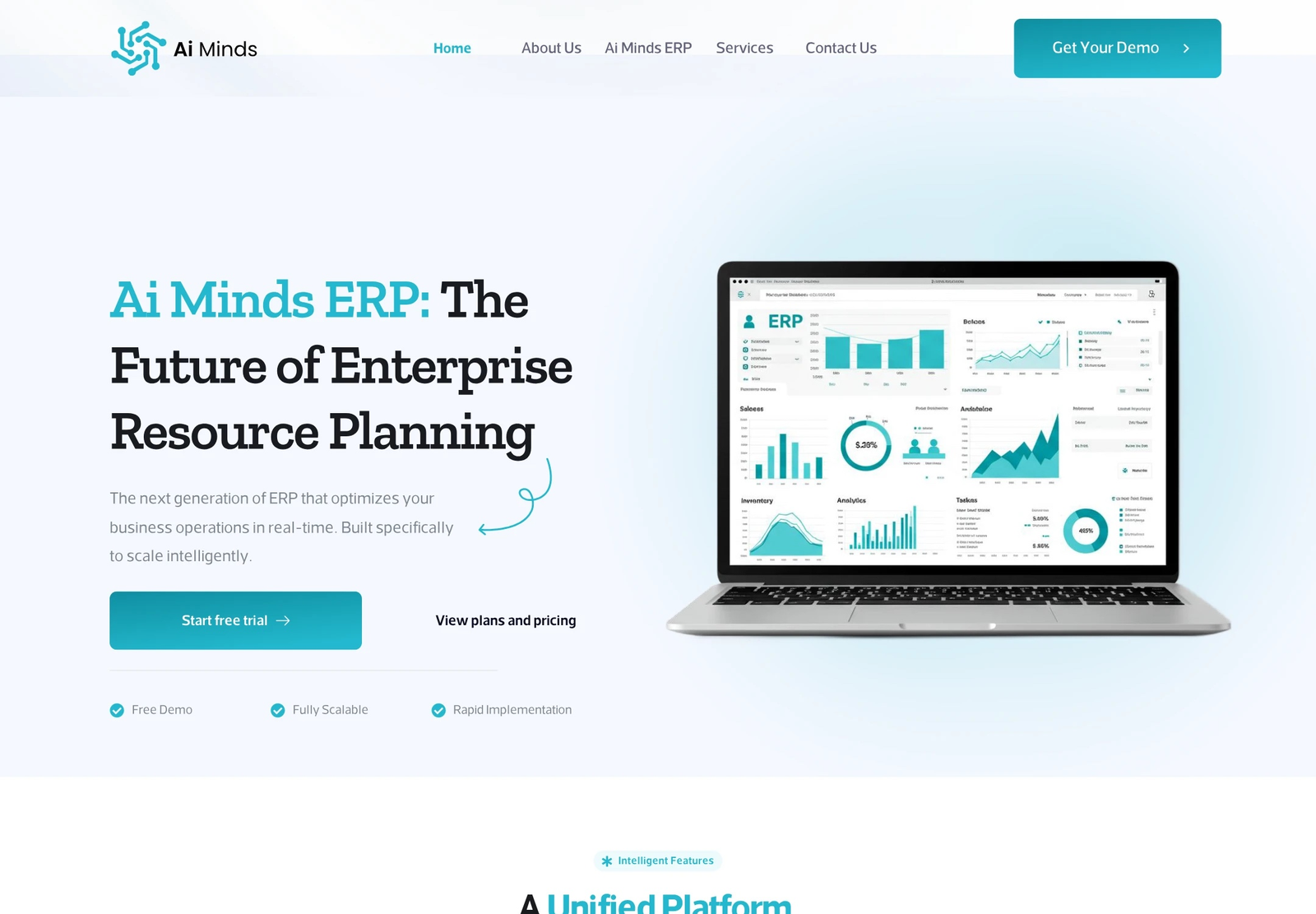
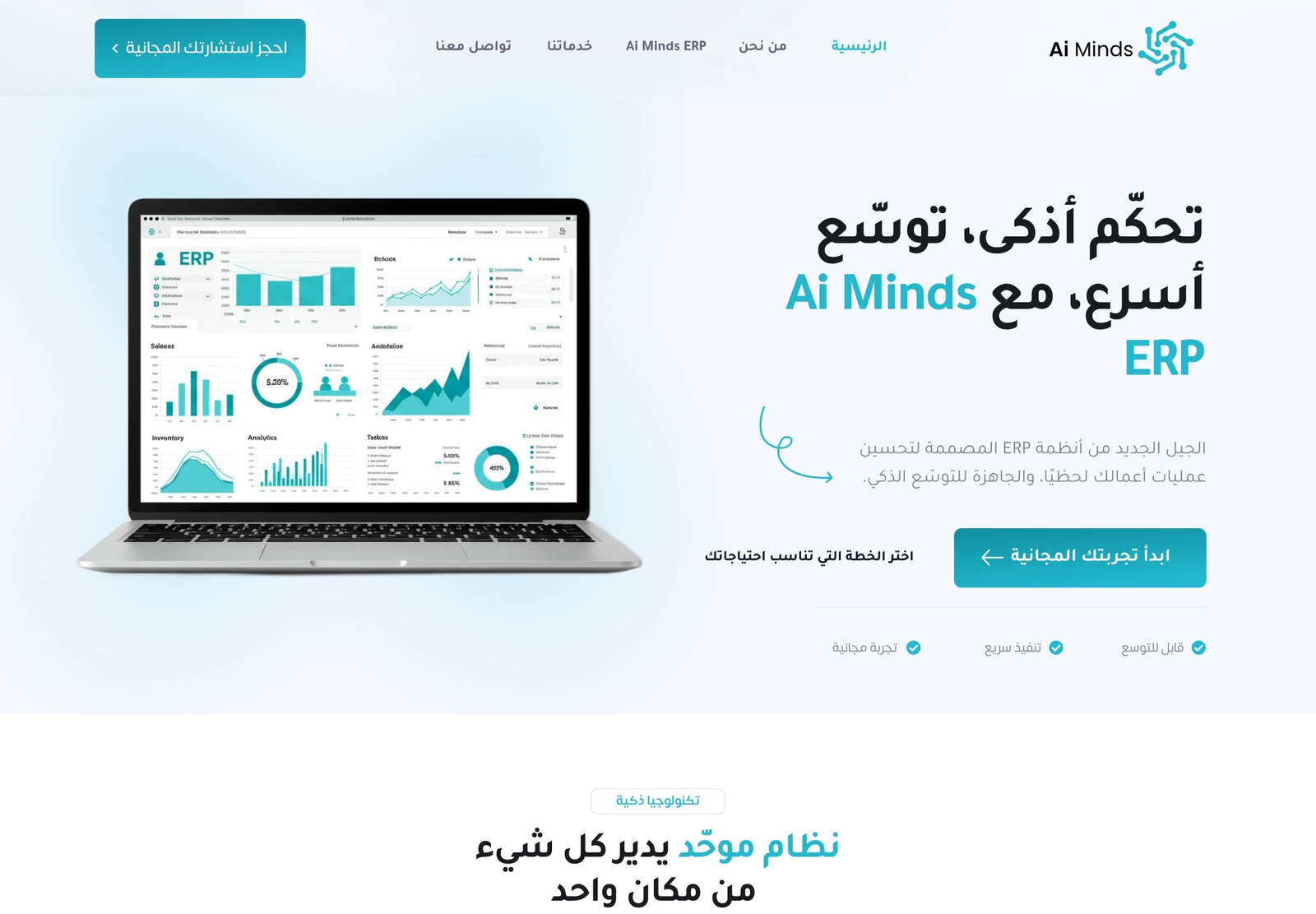
The product has its own name, proposition and route into evaluation.
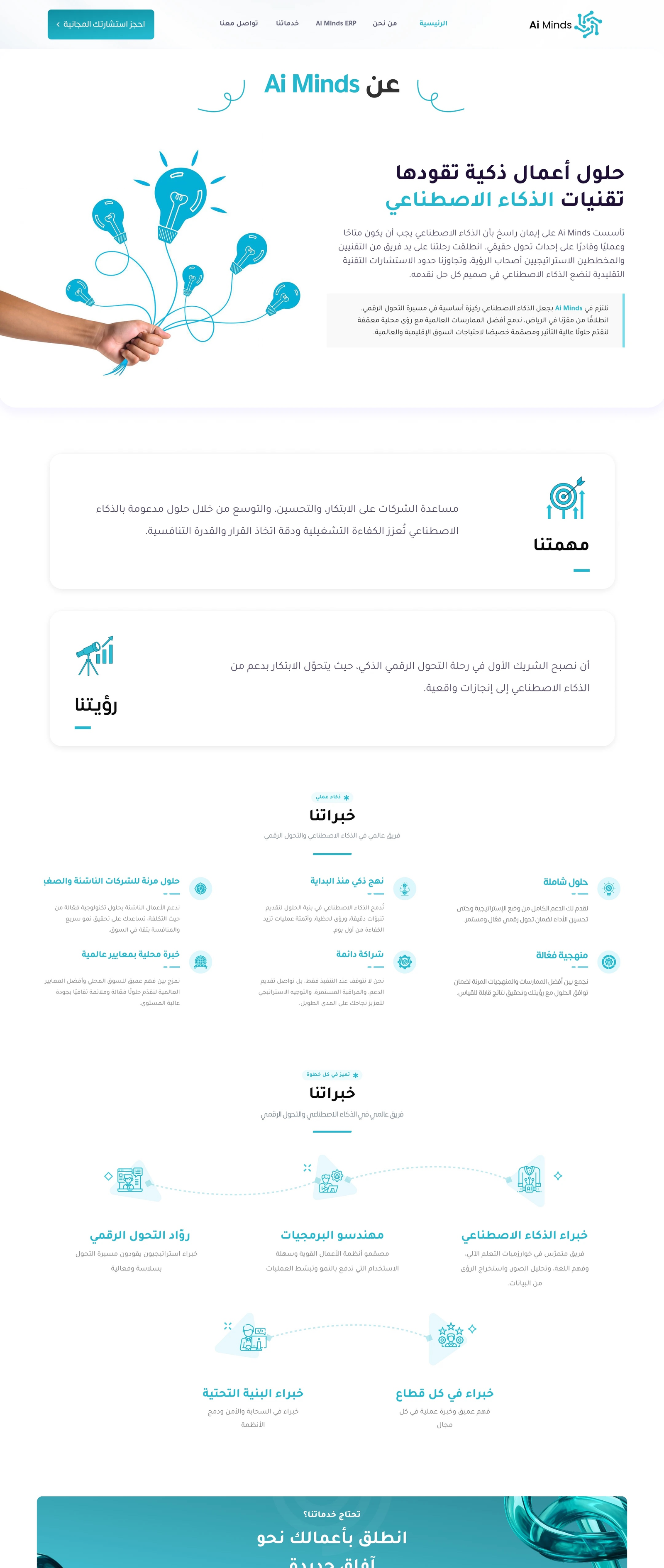
Company identity and expertise have space of their own, separate from the product explanation.
Its counterpart appears in Company, service and product each need a different argument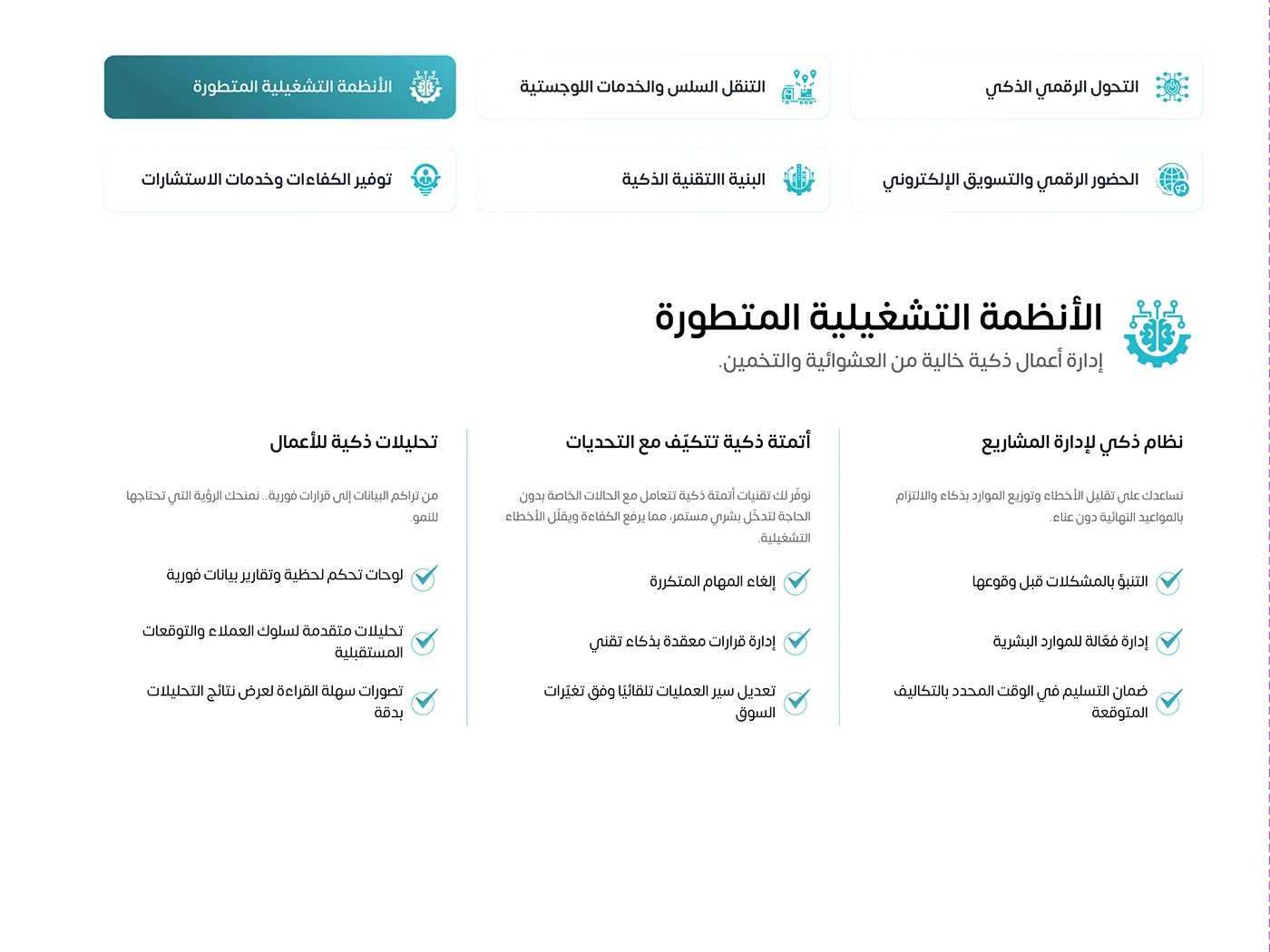
Project management, automation and business intelligence each receive a distinct explanation.
Its counterpart appears in The service components reveal the real content work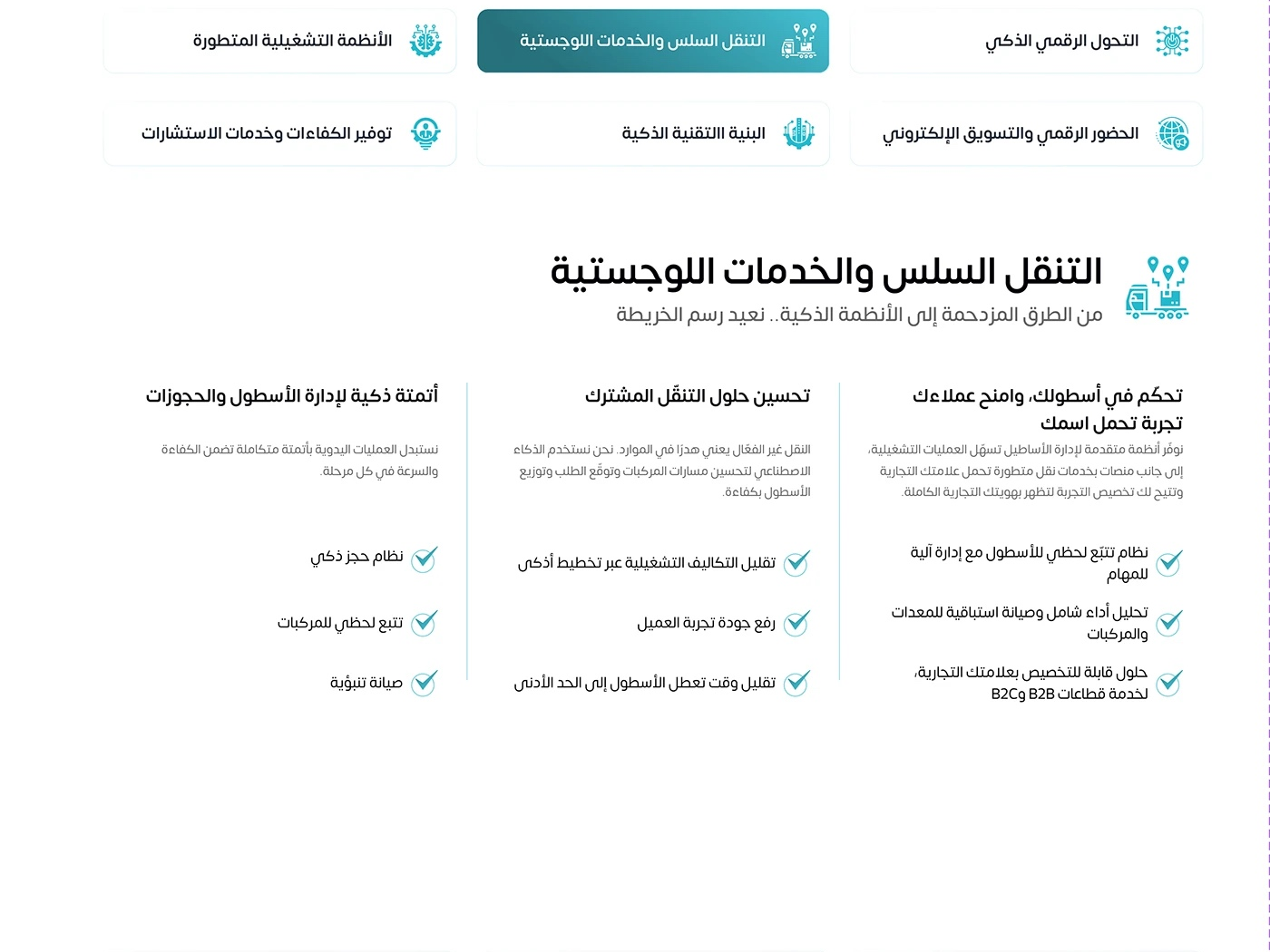
Platforms, shared mobility and booking automation make the scope of the transport offer inspectable.
Its counterpart appears in Mobility needed a scope of its own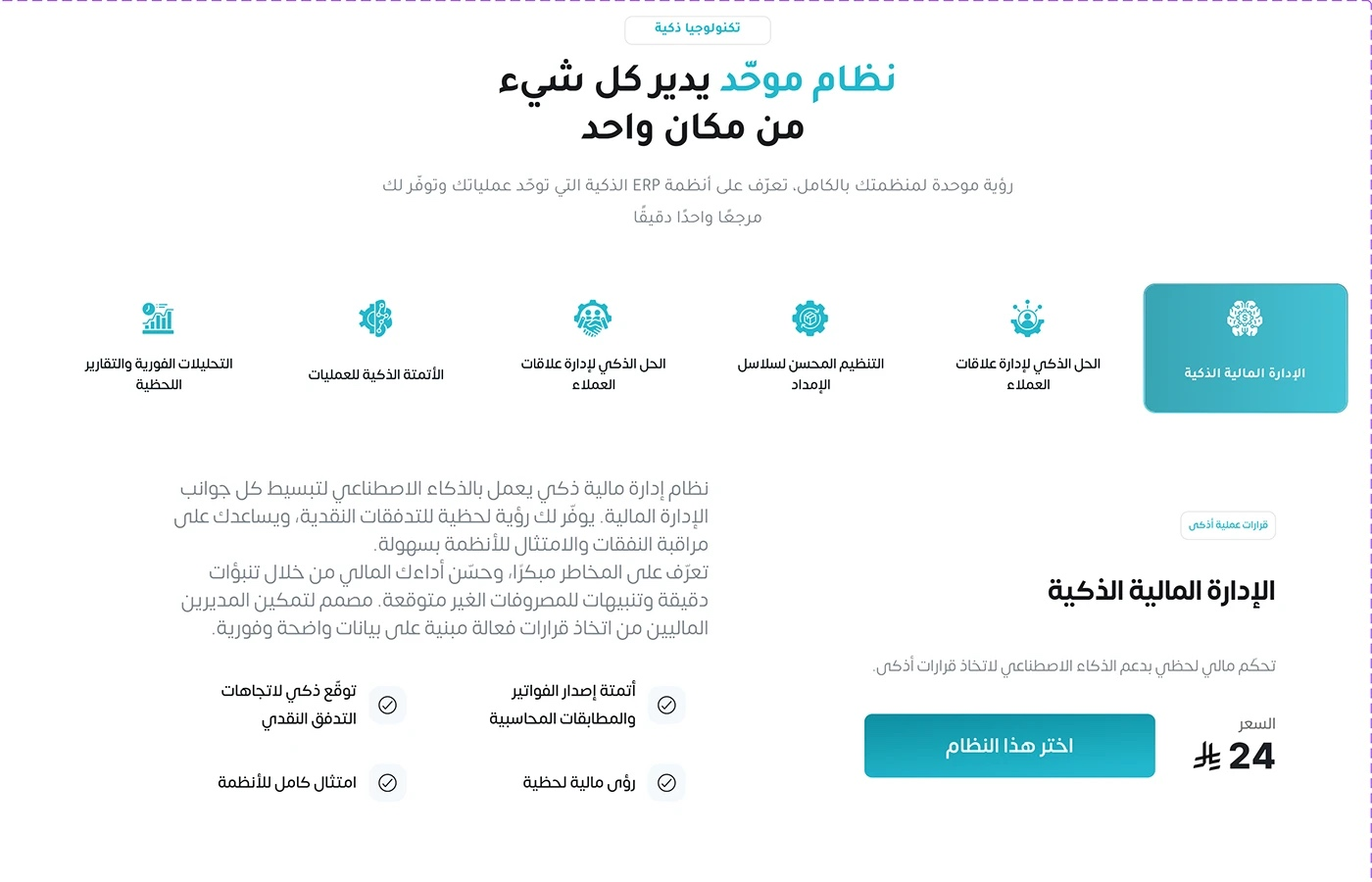
The module name, explanation and capabilities sit together before the selection decision.
Its counterpart appears in An ERP module must be understandable before it is selectable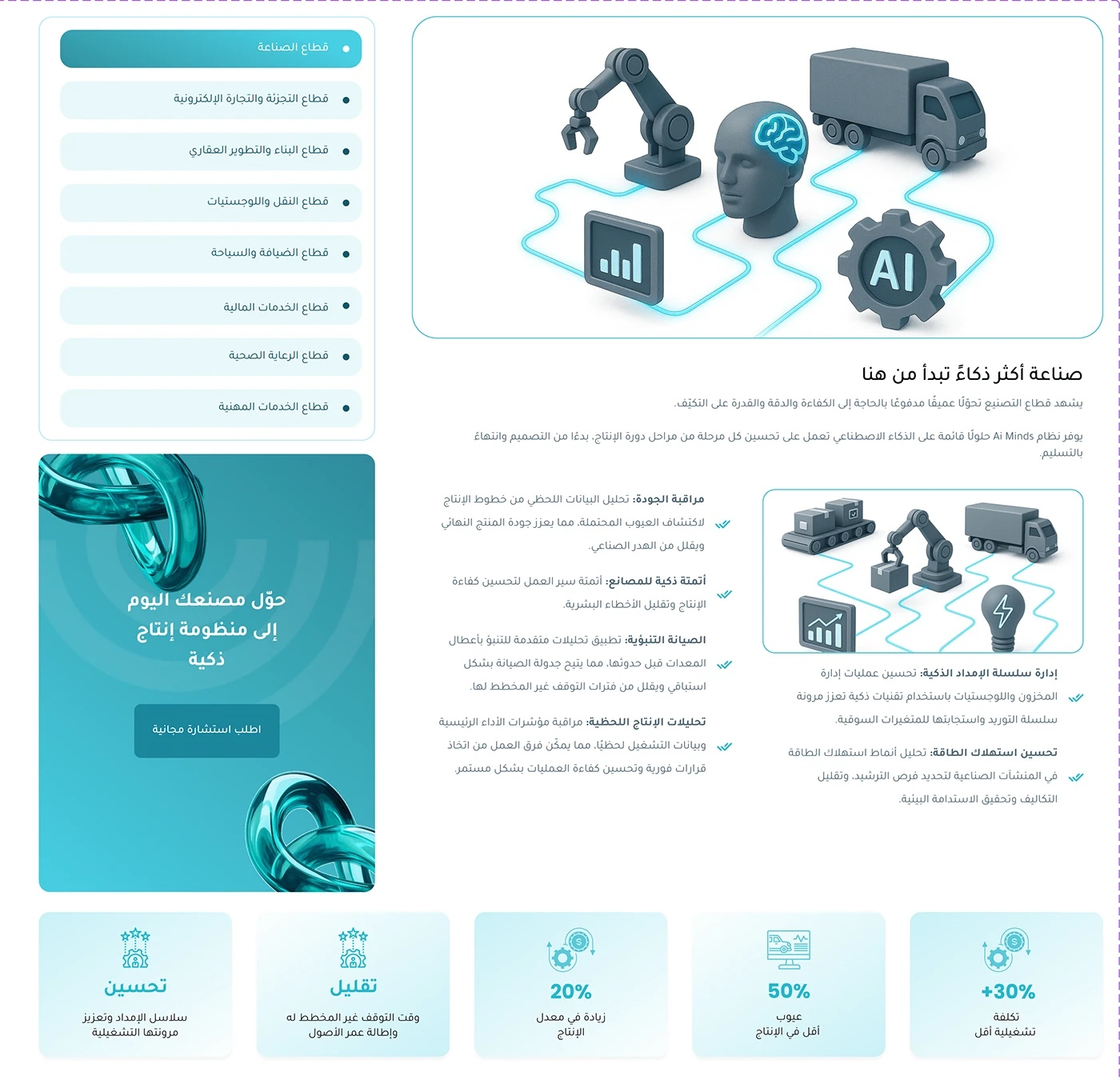
The manufacturing state changes the sector argument while retaining the ERP context.
Its counterpart appears in Sector content changes the evaluation criteriaScreens document the content and its presentation. Prices, ratings and numerical claims within the original designs are not measured outcomes of this engagement.