Chasing Mistakes as a Form of Authenticity
AI has made polished writing easy to produce. Now we are asking imperfection to prove that a person was involved.
For decades, we developed technology to help people eliminate mistakes, improve grammar, and express themselves more professionally. Now that AI can produce polished language almost instantly, some people are deliberately introducing imperfections to make their writing seem human.
The reversal is difficult to ignore. We spent years treating errors as something to remove from finished work. Now an error can be offered as evidence that the work belongs to us.
In a discussion among self-published authors, a writer described finding a typo in a book that had already been distributed; and correcting it would mean uploading a new manuscript. Another one suggested leaving it alone because the mistake might reassure readers that the book had not been written by AI. The writer did not embrace that advice, and the responses disagreed about it. It is one conversation, not evidence of a widespread practice. But the suggestion itself is revealing: the mistake had acquired a second job, proving a person was there.
The suspicion extends to ordinary punctuation. In 2025, a Hacker News contributor created a leaderboard of people who had used a particular punctuation mark before ChatGPT existed. A stylistic habit had become associated with AI strongly enough that someone thought to assemble its pre-AI history.
Once readers begin interpreting fluency, punctuation and familiar phrasing as possible evidence of machine involvement, writers face an unusual incentive. They can find themselves editing not just to express an idea accurately, but to avoid sounding like a tool they may never have used.
That gives AI influence over our writing even when we do not ask it to write anything.
What polished writing used to tell us
Clear writing takes work. You choose what matters, find a structure, cut repetition, and discover that a sentence you liked does not survive closer inspection. A finished piece can carry some evidence of that effort, even though fluent writing has never guaranteed careful thinking.
Generative AI has weakened the relationship between the appearance of effort and the effort behind it. A vague instruction can produce a competent-looking memo. A half-formed opinion can come back as an orderly argument, complete with supporting points and a conclusion. The reader encounters something finished, although the person who requested it may still be deciding what they think.
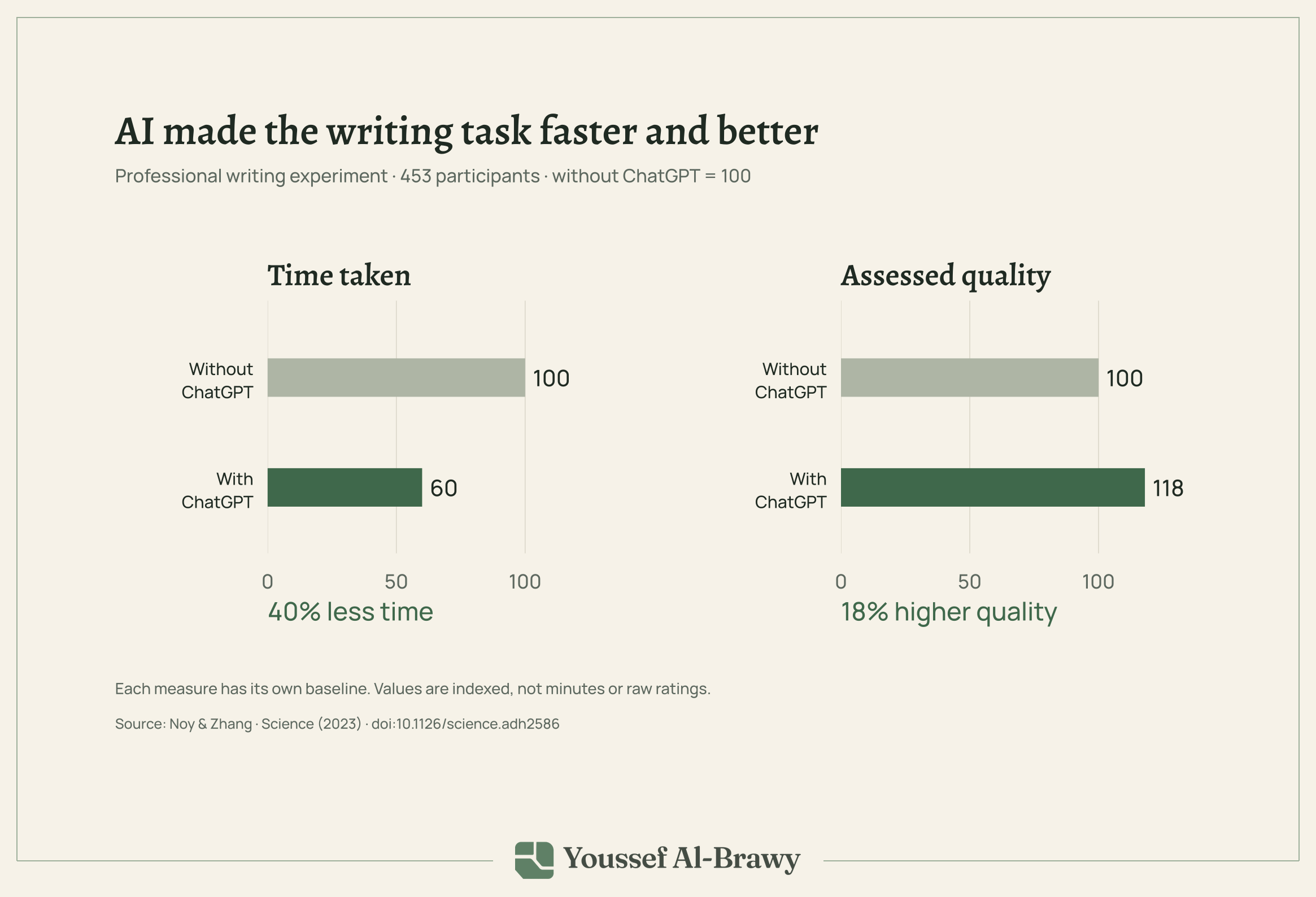
There are undeniable benefits to this capability. In a 2023 experiment involving 453 college-educated professionals, Shakked Noy and Whitney Zhang found that access to ChatGPT reduced the time spent on assigned writing tasks by 40% and increased assessed output quality by 18%. These were specific, midlevel professional writing tasks, not a universal test of human creativity. Within that setting, the gains were substantial. Science, 2023.
This is important because the argument should not be that good writing ought to remain difficult. Someone with an excellent understanding of a subject may still struggle to communicate it. A writer working in a second language can benefit from assistance without surrendering the substance of their ideas. Better expression is a genuine improvement.
The more difficult question begins when the assistance extends beyond expression. If a tool supplies the claim, the supporting explanation, and the response to objections, the user is no longer merely refining a sentence. They must decide whether the argument deserves their agreement.
A polished paragraph can make that unfinished intellectual work easy to overlook.
When the answer arrives before the thinking is finished
Writing is often how we discover the limits of our understanding. Someone begins with the claim that customers want simplicity, then tries to explain which customers, what simplicity means in practice, and what those customers would give up to obtain it. The sentence becomes harder to finish because the idea needs more thought.
That difficulty is useful information. It reveals where the reasoning has not caught up with the confidence of the claim.
A complete AI-generated answer can conceal the same gap. Instead of developing a position, we may begin by evaluating one that already sounds reasonable. Sometimes that is helpful: an unexpected objection can reveal a weakness or an unfamiliar perspective can open a new line of thinking. But we can also accept an argument simply because its structure is familiar and its language is convincing.
A 2025 study by Microsoft Research and collaborators surveyed 319 knowledge workers and collected 936 examples of AI-assisted work. Greater confidence in AI was associated with less reported critical-thinking effort. The researchers also found that critical work shifted toward checking information, integrating responses and supervising tasks. These are self-reported associations, not proof that AI has made people less capable of independent reasoning. They do, however, identify a consequential change in where our attention goes. Lee and colleagues, CHI 2025.
This raises a better question than whether AI is making us less intelligent: are we replacing the process of forming an idea with the process of evaluating a ready-made one?
A separate experiment in education helps illustrate why that distinction matters. Researchers studied nearly 1,000 high-school mathematics students in Turkey. During practice, students using a basic GPT-4 assistant scored 48% higher than a control group. But when assistance was removed for an exam, they scored 17% lower. Another group used a guided GPT tutor that incorporated teacher-designed hints and safeguards. Their practice scores improved by 127%, while their unassisted exam scores were not statistically distinguishable from the control group's. Bastani and colleagues, PNAS, 2025.
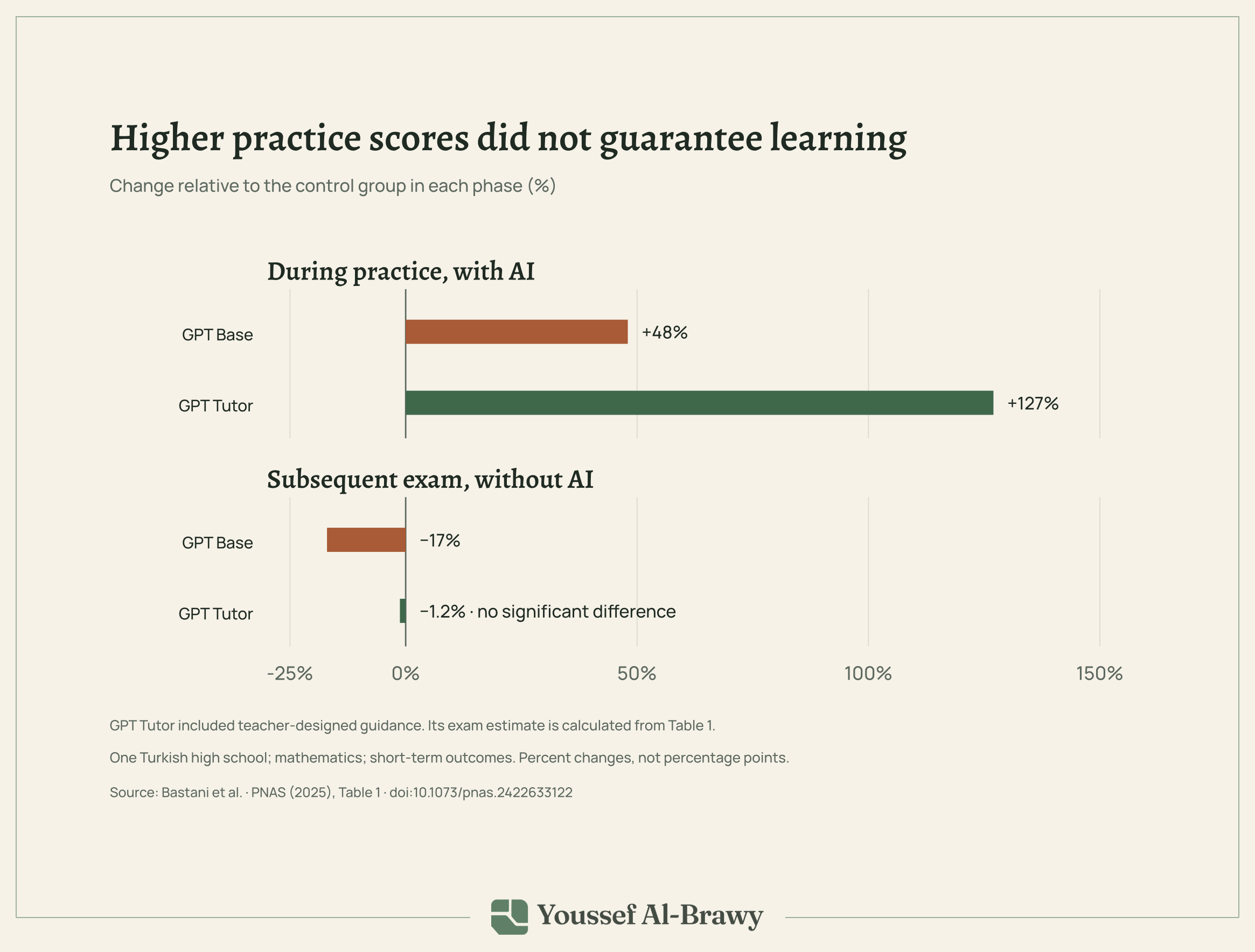
The experiment does not establish that using AI to write causes people to learn less. It does, however, illustrate a distinction that matters for writing: producing good work with assistance is not necessarily the same as developing an understanding that holds up without it. The results also suggest that how a tool is designed, and how people use it, can influence that relationship.
For writing, the question becomes: what remains of your understanding once the tool is closed? Can you explain why your central claim is reasonable, where the supporting evidence comes from, and what might lead you to reconsider your conclusion?
The finished text alone cannot tell us how much the writer understands. AI may have helped someone express an argument they already understood, or it may have supplied reasoning they have not yet examined for themselves. Both can produce equally convincing prose, but they do not necessarily leave the writer with the same understanding of the subject.
Better writing can still make us sound more alike
There is another complication. AI assistance can improve individual pieces of writing while making the larger collection of writing less varied.
In a 2024 experiment, Anil Doshi and Oliver Hauser gave some participants access to AI-generated ideas for short stories. Writers who could request up to five ideas received, on average, 8.1% higher novelty ratings and 9.0% higher usefulness ratings than writers without that access. Yet the AI-assisted stories also resembled one another more closely. Those findings describe a particular creative task, but the tension is worth considering. Science Advances, 2024.
Could AI make us better writers individually while making our writing less original collectively?
A 2026 paper in Nature Human Behaviour approached the problem through language itself. Across three studies involving seven datasets and more than 880,000 texts, researchers examined how large language models affect linguistic diversity. When models polished or rewrote text, they often preserved its core meaning while making writing styles more alike, reducing variation in measures of writing complexity by 21% to 50% across the tested datasets and models. The changes also affected linguistic cues traditionally used to infer characteristics of an author. These findings should not be read as saying that every person loses a fixed percentage of individuality when they use AI. They show that assistance can alter patterns of expression even when the information survives. Sourati and colleagues, Nature Human Behaviour, 2026.
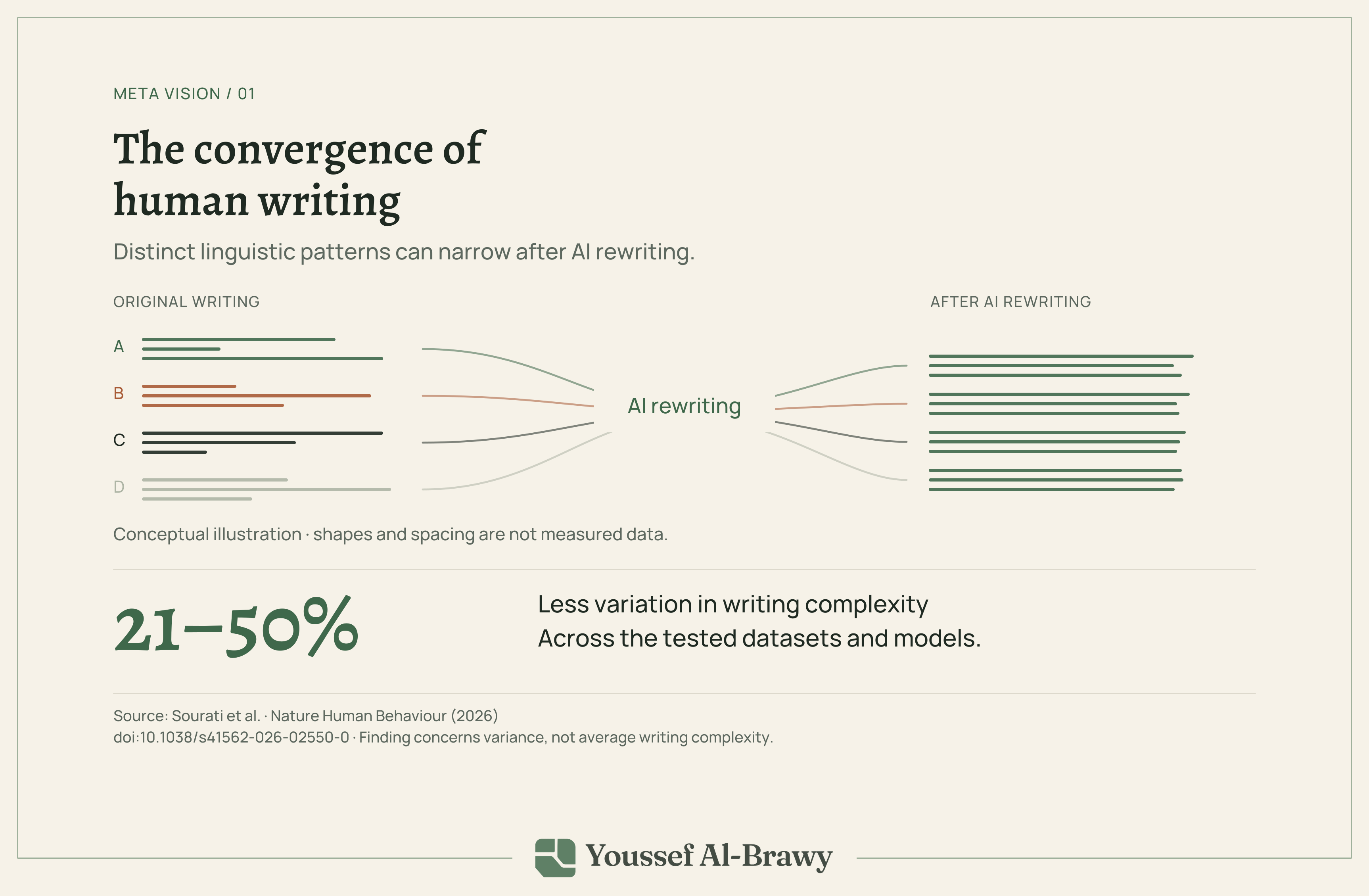
That distinction matters. Preserving what a sentence says is not always the same as preserving what makes the sentence recognizably yours.
Consider a founder describing a failed product launch. The revealing detail might be that the team had evidence customers were confused but interpreted their silence as interest. A generic account of the importance of listening to customers could express the lesson correctly while omitting the decision that made the experience worth examining.
Voice is not simply a collection of favorite words, sentence lengths, or punctuation habits. It also reflects what someone notices, which inconvenient details they include, how they weigh competing explanations, and where they are willing to acknowledge uncertainty. Those decisions shape the substance of the writing before they shape its style.
That is why the instruction to make a paragraph "sound more human" can be such a limited improvement. It may change the surface without restoring the judgment that made the original thought distinctive.
When authenticity becomes something to optimize
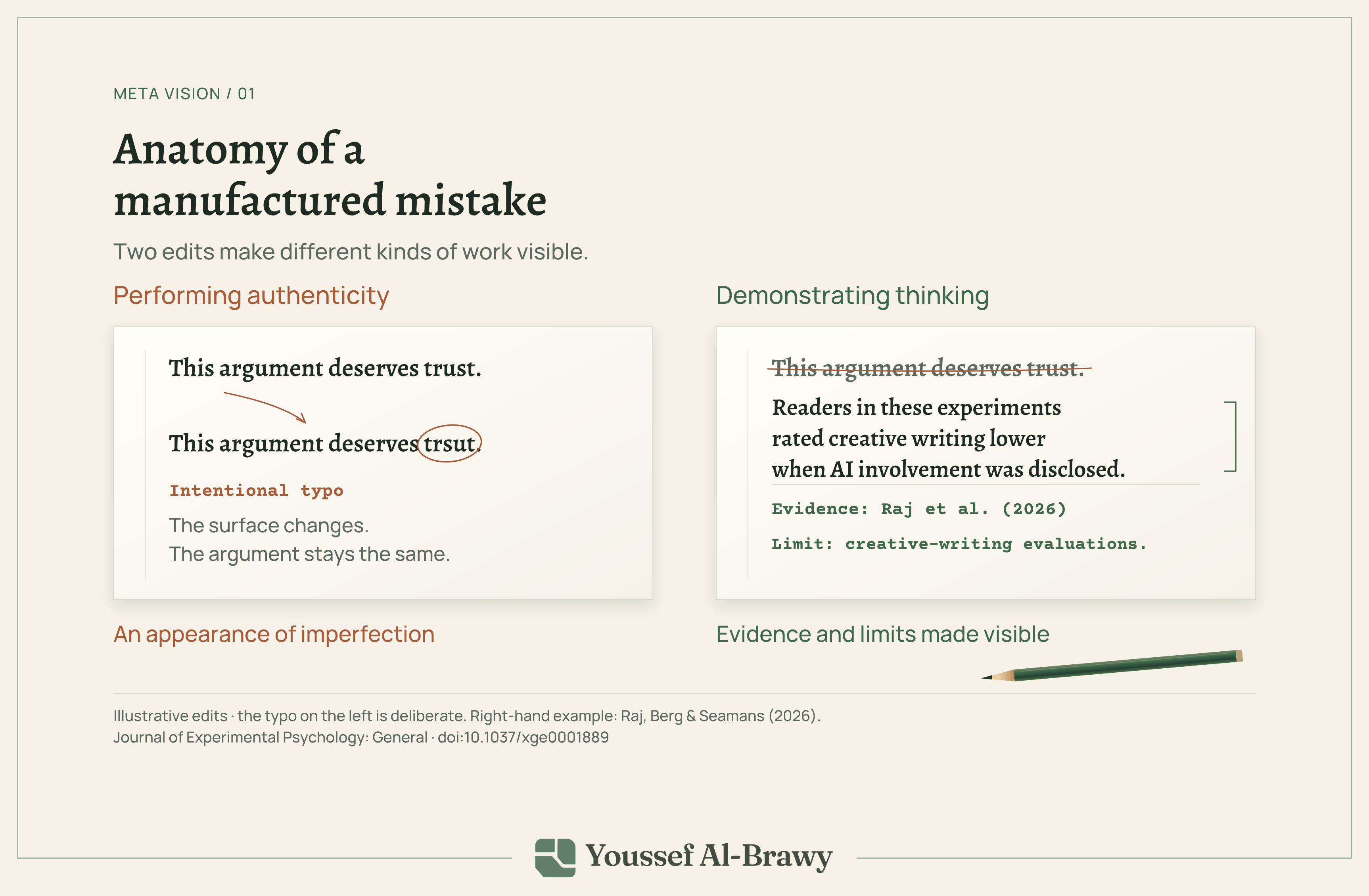
The more polished writing becomes associated with AI, the more tempting it is to treat imperfection as evidence of a human author. But the signal is unreliable. A system that can produce impeccable prose can also introduce mistakes, fragments and casual language on request. Deliberately manufactured roughness is still a kind of performance.
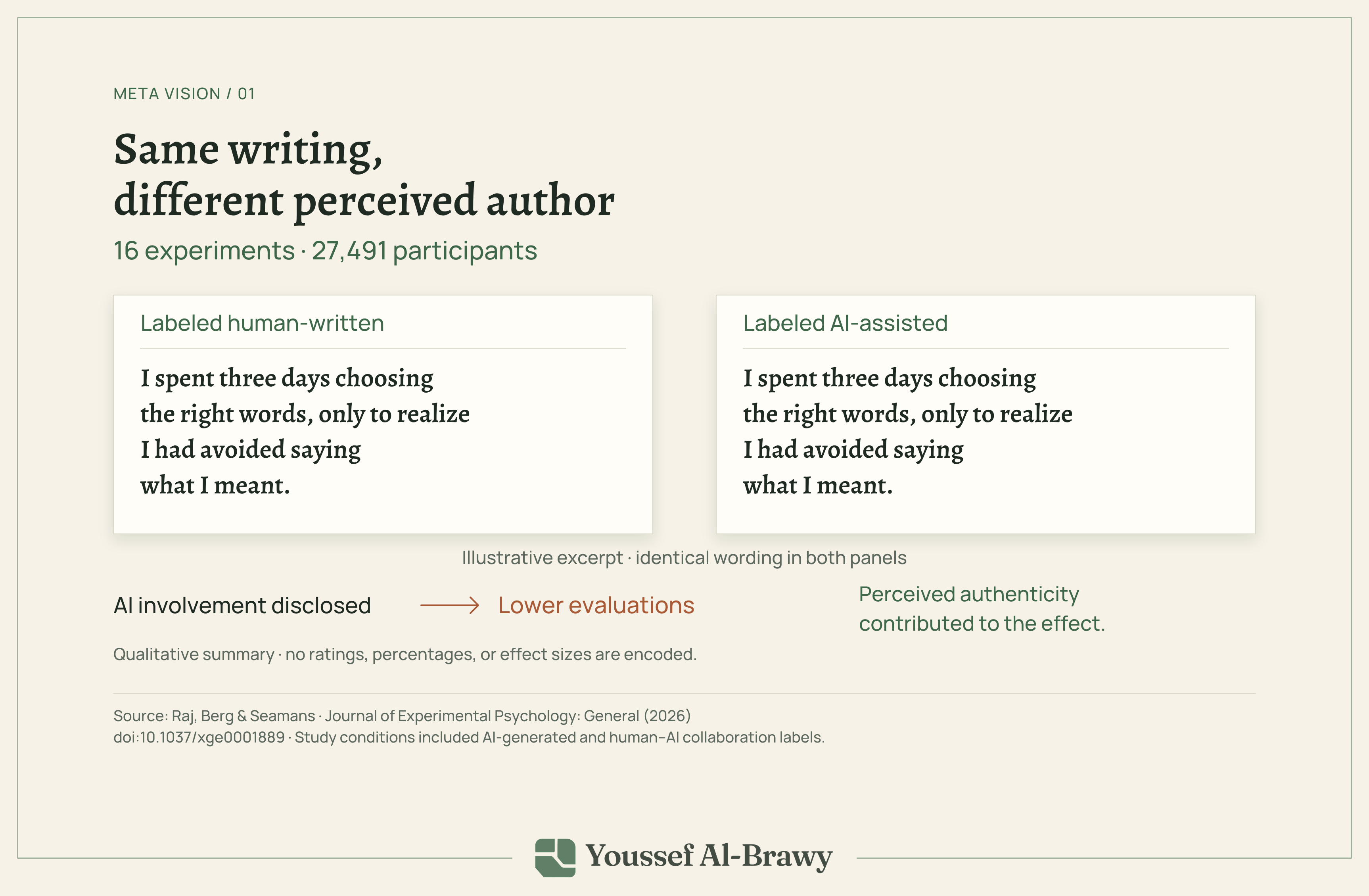
Research suggests that readers' perceptions of authorship can influence how they evaluate a piece of writing. In 16 preregistered experiments involving 27,491 participants, researchers found that evaluations of creative writing fell when readers believed AI had produced or helped produce it. Perceived authenticity helped explain the effect. The study is not evidence that human writing is always better, nor that readers can reliably recognize AI assistance. It shows that beliefs about who or what produced a text can influence how the text is received. Raj, Berg and Seamans, Journal of Experimental Psychology: General, 2026.
A smaller, preliminary study of 261 participants examined reactions to disclosed AI involvement across different kinds of communication. It found that disclosure generally worsened perceptions of the author, with particularly strong effects in social and interpersonal messages. This raises a useful distinction between the quality of the words and the human attention readers believe those words represent. Nakano and colleagues, revised January 2026.
Think about an apology. Helping someone articulate an apology clearly is not the same as asking a tool to decide what they should regret. The person receiving it is interested in more than its grammar. They want to know whether the sender understands what happened.
Yet the growing suspicion around AI-written text creates another problem. People whose ordinary writing resembles a supposedly artificial pattern may find themselves needing to prove their authorship. In a 2023 evaluation, researchers found that several AI-text detectors frequently misclassified essays by non-native English writers as AI-generated. Those findings describe the detectors and writing samples tested at the time, rather than the accuracy of every detector today. Still, they reveal the unfairness of treating particular linguistic patterns as proof. Liang and colleagues, Patterns, 2023.
The cost of suspicion is not limited to false accusations. A person may abandon a natural expression because it now looks suspicious, or introduce an unnecessary error to avoid being judged as artificial. The imagined detector becomes another editor, shaping the voice it claims to identify.
Here is the contradiction at the center of this article: when we deliberately change how we write to appear more human, we are still allowing AI to determine how we express ourselves, only in reverse.
What makes writing authentic?
If a machine can deliberately introduce mistakes and a person can produce perfectly polished writing, neither imperfection nor fluency tells us much about who created something.
Yet we increasingly look for authenticity in precisely those visible characteristics. Perhaps because the qualities we actually care about, such as attention, judgment, experience, and intellectual responsibility, are much harder to identify from a finished piece of writing.
I don't think authenticity necessarily requires writing without assistance. Someone might use AI to challenge an argument, discover a contradiction, or express an idea more clearly without surrendering ownership of that idea. Equally, someone might write every word independently and produce something entirely predictable, derivative, or poorly reasoned.
The distinction seems less about whether a tool was involved and more about what remained the writer's own.
Consider what makes someone's perspective worth reading. It might be an observation others overlooked, an interpretation shaped by personal experience, or a willingness to acknowledge evidence that complicates an otherwise convincing argument. These qualities aren't always visible in the writing itself, but they reflect something that stylistic imperfections cannot establish: the thinking behind the words.
And perhaps that's what makes the current obsession with detecting AI-generated writing so interesting. We're looking for technical evidence of something that was never purely technical to begin with.
Authenticity has always been difficult to establish. AI hasn't necessarily made it disappear. It has made some of the signals we previously relied on less dependable.
The irony is that our attempts to compensate may create another form of artificiality. A writer who deliberately makes mistakes to appear human is still adapting their voice to the expectations created by AI.
Which leaves me wondering whether our growing obsession with sounding human is gradually changing what natural human expression looks like.
Imagine reading something you genuinely admire, then discovering that AI helped write it. Would that change how you see the writing, the writer, or both? I'd love to hear where you draw the distinction.